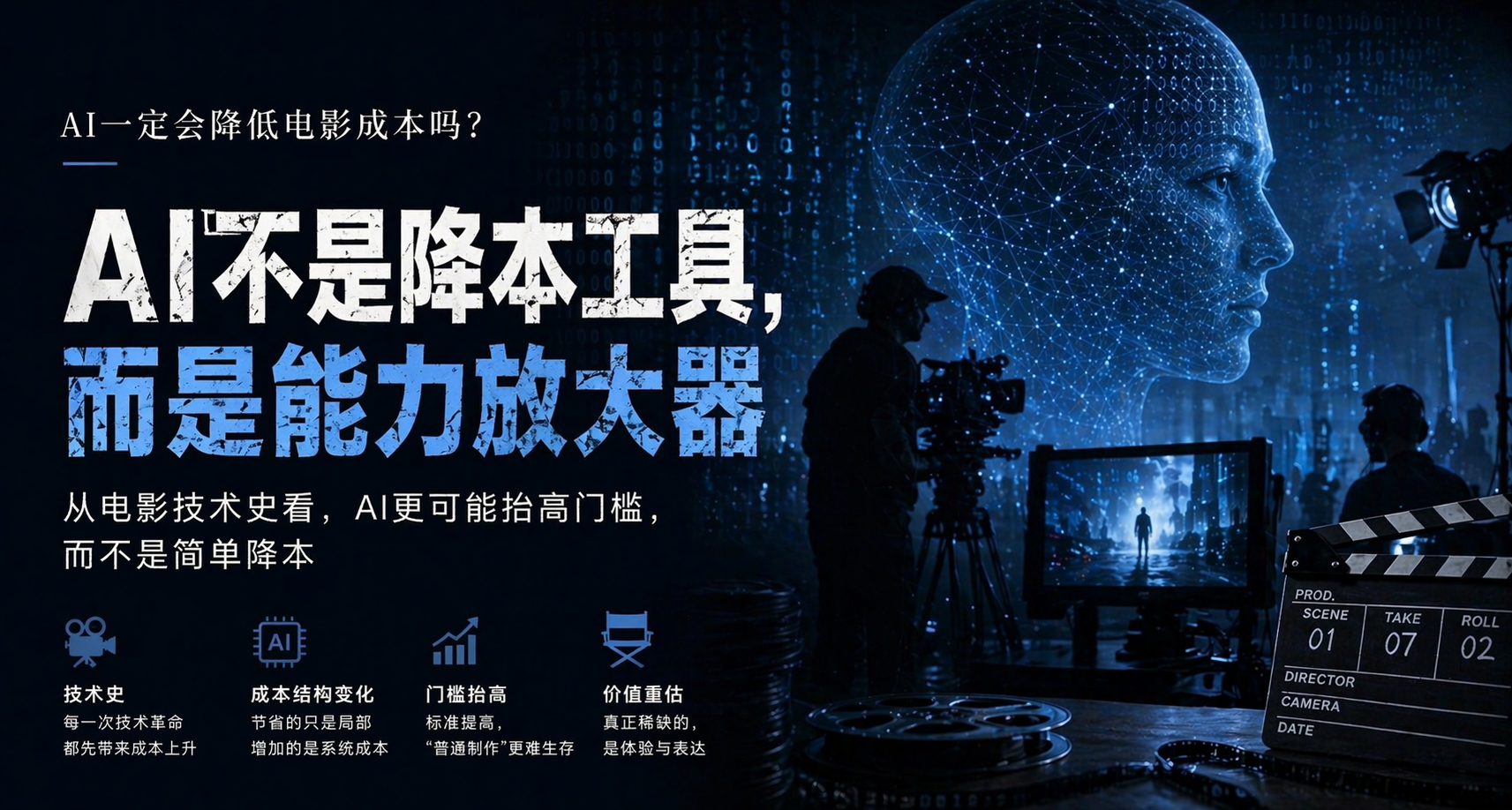
AI Will Not Make Films Cheaper
AI Will Not Make Films Cheaper
It Will Restructure Cost—and Raise the Bar
Introduction
The belief that AI will reduce the cost of filmmaking is widespread, but fundamentally incomplete.
History suggests a different pattern:
New technologies rarely reduce costs in the short term. They redefine what is possible—and what is expected.
Lessons from Film History
Sound cinema did not lower production costs; it increased complexity.
Color film was more expensive than black-and-white.
Digital effects did not simplify filmmaking; they expanded production pipelines.
Films like Jurassic Park and Avatar did not represent cost reduction. They represented capability expansion.
AI follows the same logic.
AI as a Capability Multiplier
AI allows filmmakers to generate more, explore more, and iterate more. But this abundance creates new pressures:
- Higher audience expectations
- Greater need for curation
- Increased complexity in decision-making
The cost does not disappear—it migrates.
The Shift in Cost Structure
AI may reduce certain labor costs, but it introduces new ones:
- Computational infrastructure
- Model development and control
- Data management
- Quality supervision
More importantly, it increases what we may call selection cost. When hundreds of creative options can be generated instantly, choosing the right one becomes more difficult, not less.
Industry Polarization
AI is likely to compress costs in standardized content—advertising, short-form media, and templated production.
But in high-end filmmaking, the opposite may occur:
- Standards rise
- Expectations increase
- Production becomes more demanding
The industry will polarize:
Low-end content becomes cheaper
High-end content becomes more expensive
Conclusion
AI is not a cost-reduction tool. It is a capability amplifier.
It will not make filmmaking inherently cheaper.
It will make mediocrity unsustainable.
The real impact of AI is not lower cost—but higher thresholds.